

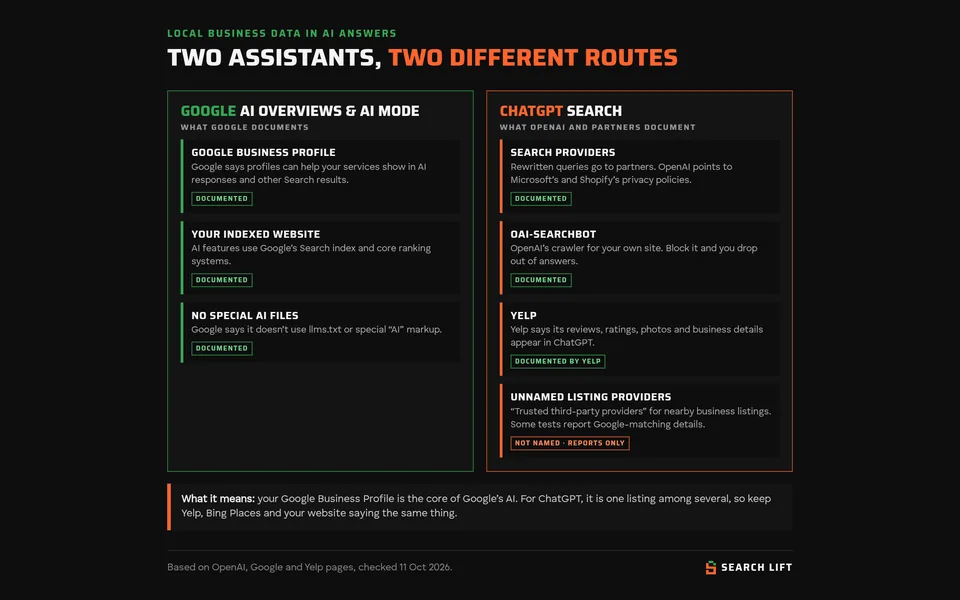
Not officially. OpenAI doesn’t name Google Business Profile, or Google Maps, as a source for ChatGPT. It says ChatGPT search uses partner search providers, its own crawler (OAI-SearchBot) and unnamed “trusted third-party providers” for nearby business listings, and Yelp says its reviews and business details appear in ChatGPT. Some independent tests have found ChatGPT’s business cards matching Google listings detail for detail, so your profile may reach ChatGPT indirectly. Keep it accurate, but don’t treat it as your only listing.
Last checked against OpenAI, Google and Yelp pages: 11 Oct 2026. We haven’t run our own ChatGPT tests for this post; findings from other firms are labelled as reports.
What OpenAI says ChatGPT uses
OpenAI’s help page on searching the web with ChatGPT and its crawler documentation describe five inputs:
- Search providers. ChatGPT search “sometimes partners with other search providers” and rewrites your question into shorter queries for them. For how those providers handle queries, OpenAI points to Microsoft’s and Shopify’s privacy policies. Google isn’t named.
- Your rough location. ChatGPT estimates your city from your IP address, so “restaurants near me” can become “top restaurants San Francisco”. Precise device location is optional and off by default.
- Business listing providers. ChatGPT may share your location with “trusted third-party providers” for things like “nearby business listings”. OpenAI doesn’t say who they are.
- Your website, via OAI-SearchBot. Sites that block this crawler “will not be shown in ChatGPT search answers”, except as plain navigational links.
- Booking partners. Restaurant availability can come from OpenTable, Resy or Yelp.
OpenAI also says ChatGPT ranks results “using multiple factors” and that placement isn’t guaranteed. It doesn’t describe any way to submit a business for inclusion.

Where Yelp fits
Yelp is the one local data partner confirmed from its own side. Yelp’s official blog says its content integration shows Yelp reviews, ratings, photos and business details inside ChatGPT, and that ChatGPT users can now book tables and join waitlists through Yelp. If customers might ask ChatGPT about your trade, a claimed Yelp listing with the same name, phone, hours and website as your Google profile is worth the hour it takes.
Does ChatGPT use Google data at all?
The honest answer: nobody outside OpenAI knows for sure, and published tests disagree.
- Reported by SearchOps (Sept 2026): ChatGPT’s place records matched businesses’ Google listings field for field, including the tracking tags on the website link saved in each Business Profile. The record’s own “provider” field was blank.
- Reported by Peekl (Sept 2026): Google pages were almost never the cited source in its scans of local ChatGPT answers, and a study it cites found Yelp data behind most business cards.
Both can be true. The cards may use Google-consistent data from a supplier, while the written answer leans on Yelp, directories and websites. A match shows the records describe the same business, not where ChatGPT got them. In practice, the details in your Google profile can turn up in ChatGPT, through a route OpenAI doesn’t name.
Google’s own AI is a different story
For Google, there’s no guesswork. Google’s guide to generative AI features says Google Business Profiles “can help your products and services to be visible in both AI responses and other Google Search results”. AI Overviews and AI Mode are “rooted in our core Search ranking and quality systems”, so normal SEO applies. Google also says you don’t need llms.txt files or special “AI” markup for its AI features.
So your profile is the core of how Google’s AI sees you. If it’s suspended, unverified or only visible to you, fix that first. Our Google Business Profile service covers those fixes.
What to fix, and where
| Listing or page | Which AI it feeds | What to do |
|---|---|---|
| Google Business Profile | Google Search, Maps, AI Overviews and AI Mode. Possibly ChatGPT cards (reported, not confirmed). | Exact real-world name, the most specific category, current hours, a working website link. |
| Yelp | ChatGPT (confirmed by Yelp). | Claim it and match every detail to your Google profile. |
| Bing Places | Bing. OpenAI points to Microsoft for its search partners, but doesn’t say it uses Bing Places data. | Claim it and keep every detail matching. |
| Your website | ChatGPT via OAI-SearchBot; Google via its index. | Let OAI-SearchBot crawl. Say plainly what you do, where, and for whom. |
The goal isn’t to be listed everywhere. It’s that every record an assistant might match to you says the same thing.
Check that ChatGPT can read your site
- Open yoursite.com/robots.txt. Look for
Disallow: /underUser-agent: OAI-SearchBot, or underUser-agent: *if OAI-SearchBot has no group of its own. Either blocks ChatGPT search. - Don’t confuse the bots. OpenAI says GPTBot is for training and is separate. Blocking GPTBot doesn’t remove you from ChatGPT search.
- Check your firewall or CDN. OpenAI recommends allowing its published OAI-SearchBot IP ranges. A rule that blocks AI bots can stop it even when robots.txt is open.
- Wait a day. OpenAI says robots.txt changes take about 24 hours to reach its search systems.
See what ChatGPT says about you
Ask ChatGPT the questions your customers ask, with your town in them, such as “emergency plumber in Leeds”. Check two things separately: are you named in the text, and is your card showing the right phone, hours and website? Answers change between runs, so repeat the check over a few weeks before acting on one result. Be wary of anyone promising a guaranteed ChatGPT spot; OpenAI says placement isn’t guaranteed.
When to get help
If you want this done properly across Google’s AI, ChatGPT and Perplexity, our AI search optimization service starts with the same crawler-access and listing checks. Not sure where you’re missing? Run the free Search Gap check; we’ll show where Google, Maps and AI answers name someone else, typically within 1–2 business days. If you’re missing from Google Maps too, start with why your business isn’t showing on Google Maps.